Share this article
There is a growing divide in how companies use AI. One side fires people. The other creates opportunities.
At AI Buddy Catalyst Labs, we picked our side early. Our mission is AI for employment. We believe AI should expand what teams can do, open new markets, and create jobs that did not exist before. Not replace the people already doing the work.
For a while, that felt like a contrarian position. The dominant narrative in tech has been clear: AI means fewer people, lower costs, leaner teams. Every earnings call, another Fortune 500 CEO credits AI for making headcount cuts possible. Wall Street applauds. The stock goes up.
Then Jensen Huang, CEO of the most valuable company on the planet, went on national television and said what we have been building around for years.
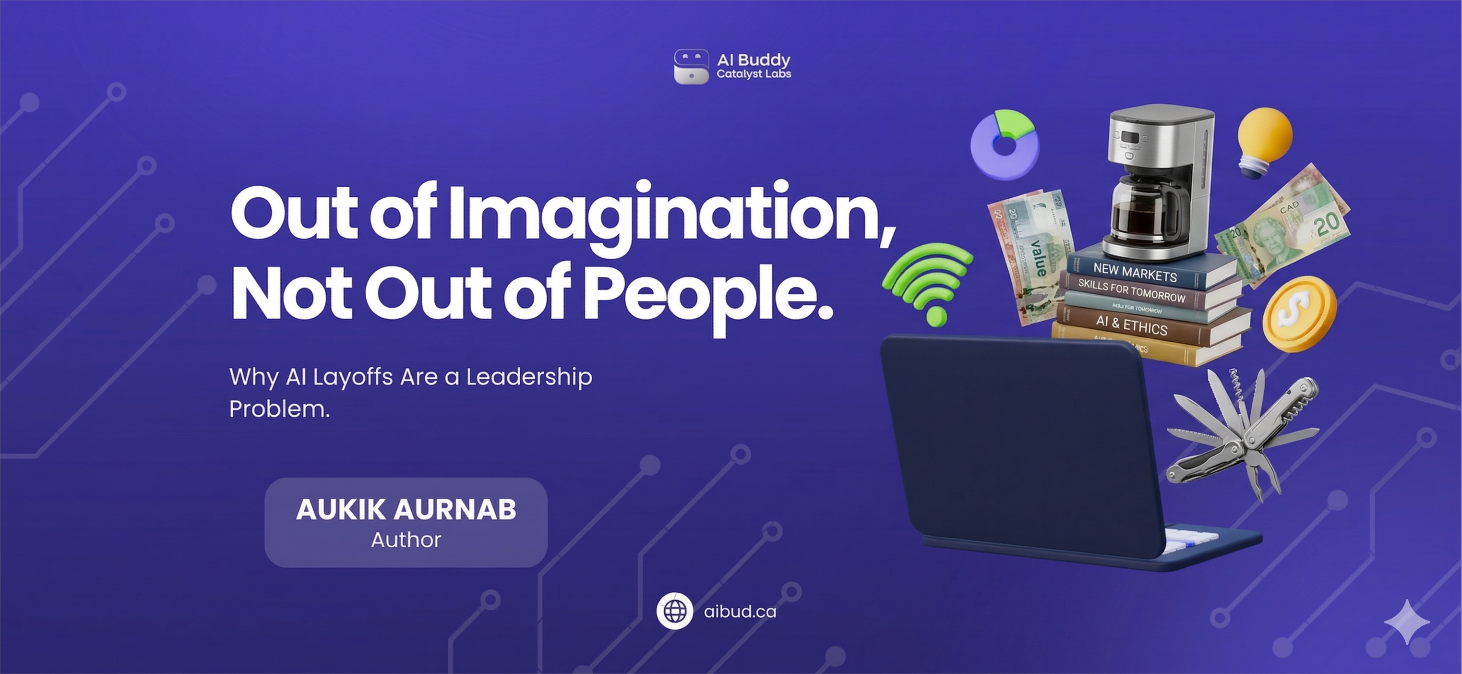
"Because you're out of imagination. For companies with imagination, you will do more with more. For companies where the leadership is just out of ideas, they have nothing else to do. They have no reason to imagine greater than they are. When they have more capability, they don't do more."
That was at NVIDIA's GTC 2026 conference. Jim Cramer asked him why Big Tech keeps announcing layoffs while crediting AI. Huang did not hedge. He called it a leadership failure. Not a technology problem. A vision problem.
And he is right.
The $700 Billion Failure of Vision
The numbers tell a story that should embarrass every executive involved.
In 2025 and 2026, the largest AI spenders in the world collectively committed close to $700 billion in AI infrastructure. At the same time, they eliminated over 60,000 jobs.
Amazon cut 30,000 corporate roles while pledging $200 billion in AI spending. That is roughly $6.7 million in AI infrastructure for every single job they eliminated. Meta prepared to lay off around 15,000 employees while doubling its AI budget to $135 billion. Microsoft quietly cut 15,000+ positions while committing up to $120 billion to AI. Google eliminated 35% of its small team managers while planning $175 billion or more in AI capex.
These are the most profitable technology companies in history. They have more resources, more talent, and more powerful tools than any businesses that have ever existed. And their collective response is to do less with fewer people.
That is not efficiency. That is a failure of vision.
Andy Jassy wrote in an internal letter that AI would "reduce our total corporate workforce." Mark Zuckerberg said projects that once needed big teams can now be done by one person. Satya Nadella called Microsoft's 220,000 employees a "massive disadvantage" in the AI race.
Wall Street rewarded every single one of them. Meta's stock climbed 3% when Reuters reported its potential 20% workforce reduction. The market is not just tolerating this. It is incentivizing companies to shrink their ambitions to the size of a cost cutting spreadsheet.
A Harvard Business Review analysis found that many companies are laying off workers based on AI's potential, not its proven performance. They are firing people before the technology can actually do those jobs. That is not strategy. That is panic dressed up as innovation.
Whenever a new AI capability drops, the first instinct for most companies is to figure out who they can let go. Ours is the opposite. We ask: how do we monetize this? What new service can we offer? What market just opened up that was not accessible before? Every breakthrough in AI is an expansion opportunity, not a reduction plan
The companies that ask the second question consistently outperform the ones stuck on the first.
Expansion Mindset vs. Contraction Mindset
Huang is proposing a framework that we have been operating by since we started AI Buddy.
The contraction mindset says: AI automates what humans do, so we need fewer humans.
The expansion mindset says: AI gives us capabilities we never had before, so we should build things we never could before.
The difference is not about the technology. It is about leadership. The same tool that one CEO uses to eliminate 15,000 jobs, another CEO could use to enter three new markets, launch products that were not feasible before, and serve customers they could never reach.
At AI Buddy, every developer on our team works with AI agent tooling daily. We are distributed across 7 countries. AI did not let us run with fewer people. It let us build things that a team our size should not be able to build. We ship large scale, multi tenant SaaS products using agent driven development pipelines. We go inside engineering organizations and help them do the same. Not by replacing their teams. By making their teams capable of things they could not do before.
That is what the expansion mindset looks like in practice.
And the data overwhelmingly supports it.
McKinsey's research on top AI performers, the companies getting 20% or more of their operating income from AI, found they are twice as likely to prioritize creating entirely new revenue sources over cutting costs. Accenture's data shows companies with the highest AI maturity grew 4.7 times faster than the least mature. PwC's 2025 Global AI Jobs Barometer, analyzing nearly one billion job ads across six continents, found that AI exposed industries see 3x higher revenue growth per employee.
The companies winning with AI are not the ones using it to do the same things cheaper. They are the ones using it to do things that were previously impossible.
AI for Employment Is Not Idealism. It Is What the Data Shows.
The fear narrative is loud. The evidence tells a different story.
The World Economic Forum's Future of Jobs Report 2025 projects that AI and technology will create 170 million new jobs globally by 2030 while displacing 92 million. That is a net gain of 78 million jobs. Not hypothetical. Based on employer survey data from companies across every major economy.
The European Central Bank's March 2026 study found that companies deploying AI at scale were 4% more likely to be hiring than companies not using AI. The growth was driven specifically by companies using AI for research, development, and innovation. Not cost cutting.
Workers with AI skills now command a 56% wage premium, up from 25% the year before. AI Engineer postings grew 143% year over year. Prompt engineer roles grew 136%. LinkedIn ranked AI Engineer as the number one fastest growing job category in the United States in 2025.
IBM tripled its entry level hiring for 2026 despite deep AI adoption. A survey of 1,500 early stage companies found 68% of AI using startups are actively growing their workforce. Insurance agencies using AI are adding headcount because AI generated insights create demand for more licensed professionals handling more complex cases.
History reinforces the pattern. When ATMs were introduced, everyone predicted the end of bank tellers. ATMs did reduce tellers per branch from 21 to 13. But lower operating costs allowed banks to open 43% more branches. Total teller employment grew through the 2000s. The internet supported 2.3 million American jobs in 1999. By 2025, that number was 28.4 million, growing 12 times faster than the broader labor market.
Every major technology wave creates short term displacement and long term expansion. AI is no different. But the expansion only happens when leaders choose it. That choice is what "AI for employment" means. It is not wishful thinking. It is a deliberate decision about how to deploy the most powerful tools ever built.
A Growing Chorus Agrees
Jensen Huang is the loudest voice making this case. He is far from the only one.
Satya Nadella, despite Microsoft's own layoffs, has consistently framed AI as augmentation: "I definitely fall into the camp of thinking of AI as augmenting human capability and capacity." At Davos 2026, he positioned AI skills as the new pathway to jobs and mobility.
Tim Cook backed the expansion thesis with real money. Apple announced a $500 billion U.S. investment creating 20,000 new jobs, with 40% focused on AI driven R&D.
Marc Andreessen called the entire displacement narrative "100% incorrect" and "classic zero sum economics," arguing that jobs persist longer than individual tasks.
The academic evidence runs even deeper. Erik Brynjolfsson, director of Stanford's Digital Economy Lab, showed that AI assisted call center workers achieved 14% productivity gains, with 35% gains for junior employees. He coined the concept of the "Turing Trap," a warning against designing AI to replace humans when it should be augmenting them. The trap is building AI that mimics what people do instead of expanding what people can do.
David Autor at MIT published research arguing AI could reverse four decades of job polarization by enabling workers without elite credentials to perform expert level tasks. His distinction is the one that matters most: an automation tool eliminates expertise. A collaboration tool is a force multiplier for expertise.
That distinction is the foundation of everything we do at AI Buddy. We build collaboration tools, not automation replacements. We help teams become force multipliers, not casualties of a cost cutting exercise.
Yes, Huang Is Self Interested. That Does Not Make Him Wrong.
I want to address the obvious critique because it is valid and worth confronting directly.
NVIDIA's fiscal year 2025 revenue hit $130.5 billion. Data center sales made up 88% of that, roughly $115 billion, up 142% year over year. Jensen Huang profits directly from companies buying more GPUs. His argument that every $500,000 engineer should consume at least $250,000 in compute tokens is, quite literally, an argument for more NVIDIA spending.
If the dominant corporate response to AI is cost cutting and consolidation, NVIDIA's addressable market eventually contracts. Huang needs his customers to think bigger. His philosophy and his business model are perfectly aligned.
But self interest does not equal wrong. A doctor who profits from treating patients is not wrong about the value of medicine. The data independently validates everything Huang said. Companies using AI for growth outperform those using it for cost reduction. Historical technology waves consistently created more jobs than they destroyed. Research from the WEF, ECB, PwC, McKinsey, Stanford, and MIT all point in the same direction.
Huang may have a $130 billion reason to be optimistic. But the evidence is optimistic too.
What AI for Employment Actually Looks Like
AI for employment is not a slogan. It is an operating philosophy.
At AI Buddy, we live this. Every developer on our team works with AI agents daily. When new AI tools land, we don't shrink the team. We find new ways to use them. New services to offer. New problems to solve for clients. That same approach is what we bring to engineering organizations we work with. We help them adopt agent driven development not to cut people, but to ship more, enter new markets, and take on work that was previously out of reach.
When I consult with a 300+ employee engineering organization on AI transformation, the goal is never "how do we do this with 200 people." The goal is "what can 300 engineers build when every one of them has an AI agent as a collaborator." The answer is always bigger than what leadership initially imagined.
That is the point. AI should make your ambitions bigger, not your team smaller.
The WEF, PwC, and Stanford's Digital Economy Lab all arrived at the same conclusion independently. The outcome of AI depends entirely on how it is deployed, not on the technology itself. Companies that treat AI as a collaboration tool see growth. Companies that treat it as a replacement tool see short term savings and long term stagnation.
Brynjolfsson calls the wrong approach the "Turing Trap." Huang calls it a failure of imagination. We call it the opposite of what we are building.
The Question Every Leader Needs to Answer
You have more capability than any business leader in history. AI tools that would have seemed like science fiction five years ago are available to your team right now.
The question is simple: what are you going to do with them?

Aukik Aurnab
Technology leader driving innovation in AI automation and workflow optimization. Builds scalable solutions that empower teams to achieve more with intelligent tools.