

Share this article
Imagine you’re on a call with a promising prospect. You’ve done your research, your pitch is polished and then they say, “Let’s revisit this next quarter.” Do you know exactly what to say next?
If you hesitate, you’re not alone. And that’s precisely why sales role play training exists. Recently, I had the opportunity to participate in an intensive role play session with Arlen Myers, a sales coach and marketing consultant with over 15 years of experience training B2B sales teams across North America. What followed was one of the most instructive professional development exercises I’ve encountered and the lessons are worth sharing.
Why Sales Role Play Training Accelerates Professional Growth
Most salespeople learn in one of two ways: trial and error in live conversations, or deliberate practice in simulated ones. The first is costly. The second is where real growth happens.
Role play creates a controlled environment where you can experiment, fail safely, and receive immediate feedback. The more realistic and challenging the simulation, the faster you develop the instincts needed for high stakes client interactions.
Lesson 1: Preparation Is the Foundation of Sales Confidence
One of the clearest takeaways from the session was the direct link between structured preparation and confidence on the call.
Having invested time organizing my approach beforehand, I was able to stay composed, think clearly, and respond naturally even when the conversation shifted unexpectedly. This wasn’t luck. It was the payoff of deliberate prep.
What effective sales preparation looks like:
- Researching the prospect’s industry, pain points, and goals
- Anticipating likely questions and objections
- Defining the clear outcome you want from the conversation
- Practicing your opening and key talking points out loud
Preparation isn’t a luxury for top performers, it's the infrastructure everything else is built on.
Lesson 2: Small Talk Is a Strategic Skill, Not Filler
One of the areas flagged for improvement in my session was a tendency to move straight into the substance of the call without first warming up the conversation.
In sales, especially when working with prospects in relationship driven cultures. Canada being a strong example, small talk is not a formality. It’s a tool. It signals respect, eases the prospect’s guard, and sets a collaborative tone before any business is discussed.
How to Build Rapport Naturally at the Start of a Sales Call
- Reference something current and relevant (a recent company announcement, a shared connection, or a timely industry trend)
- Ask a genuine, low stakes question that invites the prospect to talk
- Listen actively and mirror their energy match their pace before leading
- Keep it brief: 60-90 seconds of connection can change the entire dynamic of a call
Building rapport in sales is a learnable skill. Like any technique, it improves with intentional repetition.
Lesson 3: Handling Sales Objections Without Losing Momentum
Remember that prospect from the top of this post, the one who just told you “Let’s revisit this next quarter”? Here’s how to handle that moment.
Perhaps the most practically valuable part of the role play centered on objection handling specifically, the classic “let’s revisit next quarter” response.
This objection is easy to mishandle. Accept it too quickly and you lose momentum. Push back too hard and you damage trust. The goal is a middle path: stay engaged, acknowledge the prospect’s position, and plant the seeds for a natural follow up.
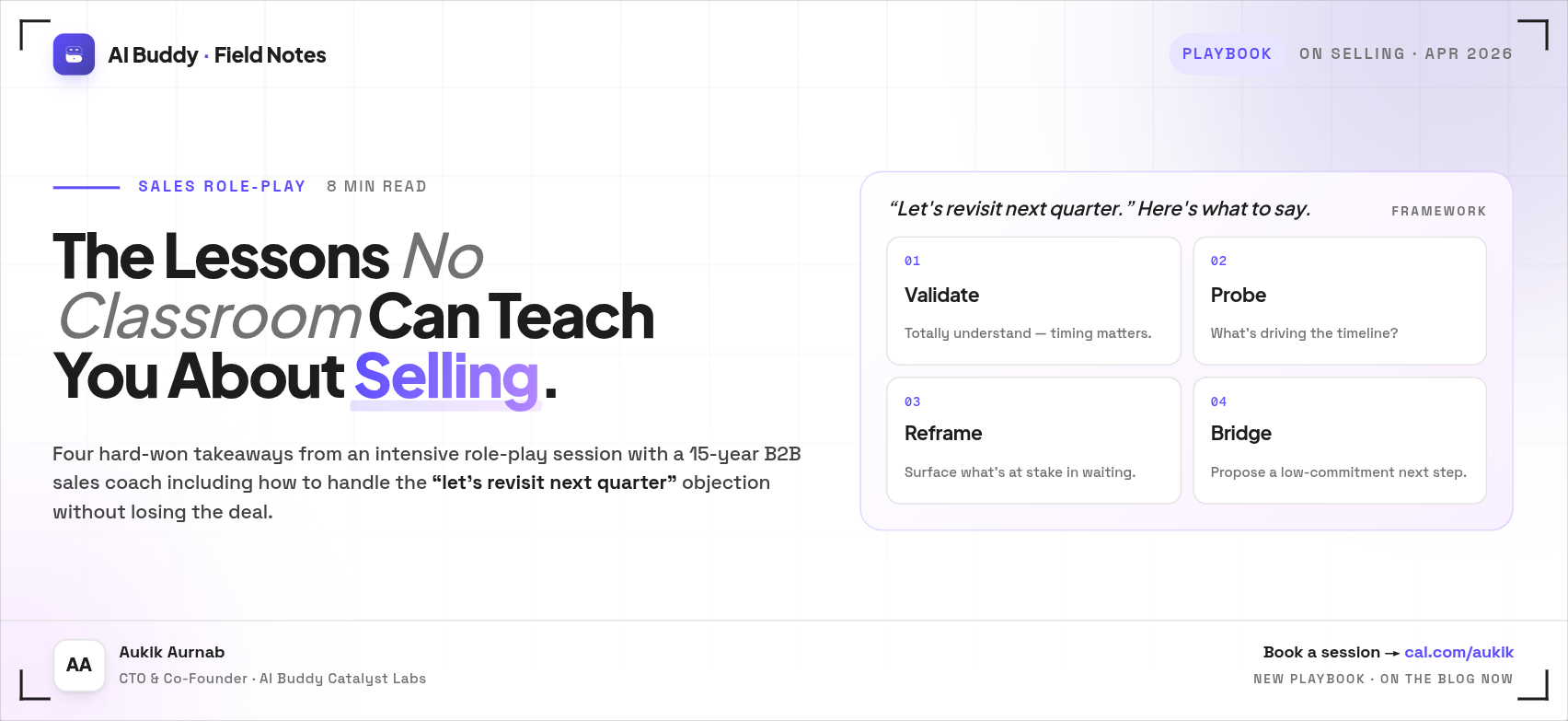
A Framework for Responding to “Next Quarter” Objections
- Validate: Totally understood, timing matters.
- Probe: Can I ask what’s driving that timeline? Is it budget, priorities, or something else?
- Reframe: Highlight what’s at stake in waiting (without creating false urgency)
- Bridge: Propose a low commitment next step: a brief follow up call, a resource to share, or a calendar placeholder
Developing a personal toolkit of responses for common objections is one of the highest ROI investments a salesperson can make in their own professional development.
Lesson 4: Difficult Simulations Create Durable Skills
What made this particular role play session genuinely valuable was its intensity. It didn’t feel like a warm up exercise; it felt close to a real client interaction, with all the pressure and unpredictability that entails.
That’s the point. The discomfort of a challenging simulation is far less costly than being underprepared in a live environment. When you’ve already navigated a tough scenario in practice, your nervous system recognizes it and responds with confidence instead of panic.
Signs your current practice is too easy:
- You always know what objection is coming next
- Your role play partner never interrupts, pivots, or goes off script
- You never feel any real pressure or discomfort during the simulation
- You finish every session feeling like it “went fine” with nothing specific to improve
How to make your role plays harder:
- Use a rotating objection deck. Write 10-15 realistic objections on cards and have your partner draw one at random mid call.
- Introduce a curveball persona. Ask your partner to play a distracted prospect, a skeptic, or a decision maker who suddenly involves a second stakeholder.
- Add a time constraint. Simulate a prospect who only has 10 minutes instead of 30. Compression forces prioritization.
- Record and review. Watching or listening back to your own simulations reveals habits you can’t catch in the moment.
How to set up a role play partner arrangement:
- Partner with a peer in a different industry so they bring a fresh, unscripted perspective
- Agree on feedback rules upfront: what to capture, how specific to be, and how to deliver it
- Rotate roles so both parties practice being the prospect it builds empathy and listening skills
- Keep sessions short (20-30 minutes) and frequent rather than long and infrequent
The Takeaway: Growth in Sales Is Built on Honest Self Assessment
Sales improvement is incremental. It doesn’t happen through inspiration alone it happens through feedback loops: practice, honest evaluation, targeted refinement, and more practice.
Sales role play training gives you exactly that loop in a safe, structured setting. By identifying both what’s working and what isn’t as I did in this session around rapport building and objection handling you can sharpen your approach before it costs you a real opportunity.
The best salespeople aren’t born confident. They become confident by practicing under pressure, one rep at a time.
Ready to Sharpen Your Sales Skills?
If this resonated with you, there are a few ways to take the next step:
- Book a role play session. cal.com/aukik: Work directly with a coach to stress test your pitch and objection-handling in a live simulation.
- Subscribe for more sales insights. https://aibud.ca/resources/newsletter: Get practical, field tested tactics delivered to your inbox.
Have a question or want to share your own role play experience? Leave a comment below. We'd love to hear what’s worked for you.

Aukik Aurnab
Technology leader driving innovation in AI automation and workflow optimization. Builds scalable solutions that empower teams to achieve more with intelligent tools.